Introduction
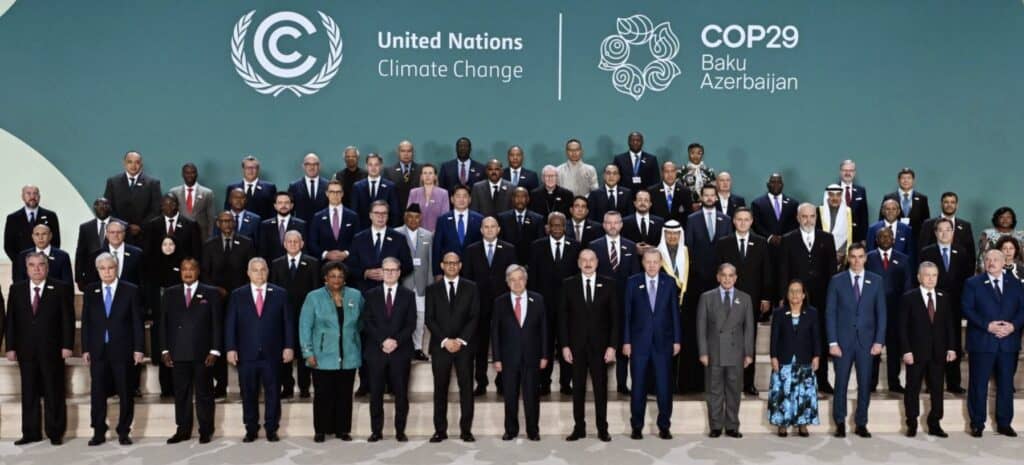
Climate change is one such aspect on which much has been written, negotiated and even debated but lesser done. The pressing issue of climate crisis recently witnessed a fundamental shift from political forums like the Conference of Parties (‘COP’) to the International Court of Justice (‘ICJ’) increasingly shape environmental governance. The recently concluded COP29 to the United Nations Framework Convention on Climate Change (‘UNFCCC’) in Baku 2024 was to mark a pivotal turn in climate finance by finalising the New Collective Quantified Goal (‘NCQG’) to supersede the previously targeted $100 billion per year set in 2009. Instead of being an opportunity to unify the global community, COP29 ended by exposing the deep fracture between developed and developing countries. With the adoption of a $300 billion annual target far below what was needed, COP29 was being termed as an outcome, a “travesty of justice.” The summit created an impression that climate conferences are becoming increasingly politically symbolic, or as economist Jayati Ghosh exclaims, “meaningless rituals”, rather than sites of binding action. Recognising this repeated failure, the UN General Assembly passed Resolution 77/276 in 2023, requesting the ICJ to step in and determine the legal obligations of states under international law concerning climate change, and to determine the legal consequences of states’ violation of those obligations. The advisory opinion also stressed upon the duty of the states to regulate the conduct of private actors in their jurisdiction and stated that human rights law constitute an essential part of the legal framework related to climate change.
ICJ’s recent advisory opinion on the Obligations of States in respect of Climate Change (‘Advisory Opinion’) represents the most ambitious expression of the ongoing global judicial turn in global environmental governance proposing that states bear universal obligations to prevent climate harm beyond specific commitments like the Paris Agreement that aims at strengthening the global response to the threat of climate change. The inherent fragility in climate change is perhaps best exemplified by the United States withdrawing from the Paris Agreement under one administration only to rejoin under another, and then withdrawing again, this reinforces the need for a legal framework that maintains state accountability independent of shifting political will or sovereign preferences. It is important to note that advisory opinions do not qualify as “decisions” under Article 59 of the ICJ Statute i.e. they do not have parties in and therefore do not bind states. Therefore, the advisory opinion is contingent upon political implementation. However, it is undeniable that this decision attempts to constitutionalise climate responsibility as an inescapable feature of contemporary statehood, which is a shift from treaty-based voluntarism to judicially declared universalism. Undoubtedly, this marks a critical juncture in international environmental law. Translation of climate obligations into justiciable individual rights expression has been noted earlier in regional cases like KlimaSeniorinnen v. Switzerland, decided by the European Court of Human Rights. In this case, elderly women successfully argued that inadequate climate policies violated their fundamental rights. Even though this is a very specific case for elderly women, this jurisprudence illuminates how climate impacts intersect with social vulnerability, aligning with ecofeminist critiques highlighting environmental degradation’s disproportionate burden on marginalized communities.
Climate Harm Prevention as Customary International Law
The advisory opinion affirmed that obligations erga omnes, that are universally binding duties owed to the international community which are not contingent on individual treaty participation. This doctrinal shift moves beyond the voluntary frameworks of climate governance, such as the UNFCCC and the Paris Agreement, and asserts that states may be held legally accountable for climate harm even if they are not parties to specific treaties. Climate governance frameworks that exist today, like the UNFCCC and the Paris Agreement, have relied on voluntary commitments, soft enforcement measures, and other non-binding actions for a long time. The Advisory Opinion’s “Beyond Paris” framework asserts that climate obligations exist independently of treaty participation, particularly relevant with the very recent the United States’ withdrawal from Paris Agreement. Although the court does not designate these obligations as jus cognes i.e., as a peremptory norm from which no derogation is allowed, it nonetheless grants them important normative weight by linking them to the protection of the global commons and intergenerational equity.
It is of utmost importance to test if by such recharacterisation by the Advisory Opinion, climate harm prevention could potentially be recognised as a principle of customary international law. Under international law, customary international law is determined by two essential elements, namely, state practice and opinio juris. State practice refers to the consistent and general behaviour of states, including their legislative actions, diplomatic conduct, and military operations, which must be widespread and representative. Opinio juris is the belief that such behaviour is carried out not merely out of habit or convenience but because it is legally required. Such belief is evidenced through official statements, votes in international organisations, and judicial decisions. Together, these elements form the foundation for identifying a rule as customary international law, as mentioned in Article 38(1)(b) of the ICJ Statute and affirmed in various landmark cases such as the North Sea Continental Shelf Cases andMilitary and Paramilitary Activities in and against Nicaragua. However, an application of these ingredients to the principle of climate harm prevention raises critical questions. First, can the court plausibly identify the “general and consistent” state practice necessary for customary law when climate action remains inadequate across most jurisdictions? The Court draws on broad state rhetoric and normative convergence, such as Nationally Determined Contributions (‘NDCs’) that are self-defined climate pledges under the Paris Agreement, outlining countries’ commitments to achieve 1.5°C, adapt to climate impacts, and secure sufficient finance. However, this comes with a foundational issue of evidence. It is difficult to see how the Court can identify the “general and consistent” state practice required for customary law when climate action remains inadequate globally. This creates a paradox where the opinion seeks to impose obligations more stringent than those states already fail to meet under voluntary treaties. Additionally, it is important to note that while states acknowledge a duty to prevent transboundary harm, they remain deeply reluctant to relinquish domestic regulatory discretion for the sake of a universal gain. Therefore, even if the general obligation were accepted, its enforcement in court would depend on establishing “a sufficiently direct and certain causal nexus” between one state’s actions and another’s injury. Without an agreed international standard for attribution, any litigation risks becoming splintered and highly politicised, undermining the very legal certainty the opinion seeks to create. Moreover, in contested areas such as the South China Sea, where territorial and jurisdictional sovereign disputes are already convoluted, a state may politicise climate harm claims as a part of its blame arsenal. States may raise environmental injury claims not to seek justice in a particular case, but to undermine a competing state’s position through strategic climate litigation that serves merely as part of arming their case. Thus, per the Advisory Opinion, any use of the climate harm approach as a litigation strategy against others would be detrimental, and politicisation of the ICJ’s norms will undermine efforts to jointly mitigate climate harms. Simultaneously, the belief that climate action is legally required, opinio juris, is inferred from global declarations, judicial decisions, and the increasing recognition of climate-related rights. However, the Court’s reliance on aspirational rhetoric rather than consistent implementation raises concerns about whether the threshold for customary law is truly met. Despite its advisory nature and aspirational tone, the opinion marks a pivotal moment in international environmental law, laying the groundwork for universal climate accountability and signalling a shift from moral persuasion to legal obligation though its enforceability will ultimately depend on political will and institutional development.
Way Forward
As the dust settles from COP29 in Baku, the global climate community is left with a characteristically mixed legacy. A significant low was the fraught negotiation over NCQG, which exposed the deep political chasms on climate finance. Yet, a notable high was the incremental progress in operationalising the Loss and Damage Fund (‘LDF’), establishing clearer mechanisms for its function. It is against this backdrop of partial success and persistent disagreement that the world now looks toward COP30 in New Zealand. The summit presents a unique opportunity for consolidation, where the political shortcomings of COP29 can be addressed by anchoring future commitments in the legal principles of the ICJ’s advisory opinion. As a leader in climate activity, New Zealand can chart the course by way of fusion of non-injury standards and positive action obligations set forth by the Advisory Opinion into the NDCs and LDF. This process consequently will link the legal obligations with the instruments of institutional action, converting the advisory perspectives into a concrete accountability. New Zealand opens an opportune window for consolidation as COP30 comes nearer, dealing with reparation rights and putting declaratory principles into actual remedies. Roadblocks persist, however, among which are determining liability for historical emissions and fixing causation. The Court’s Advisory Opinion is a moment of historic reckoning in the landscape of global climate governance. The ICJ’s legal reasoning must be protected from misuse with rigorous scientific protocols and multilateral oversight, with a set of guardrails that ensure its authority will facilitate cooperation rather than conflict in an already precarious global order.
Sanya Darakhshan Kishwar is an Assistant Professor at Jindal Global Law School, O.P. Jindal Global University, Sonipat, India and a Doctoral Candidate at National Law University, Delhi.
Jaskaran Singh Sahani is a law student at Jindal Global Law School, O.P. Jindal Global University, Sonipat, India.
Saumya Tyagi is a law student at Jindal Global Law School, O.P. Jindal Global University, Sonipat, India.