I. Introduction
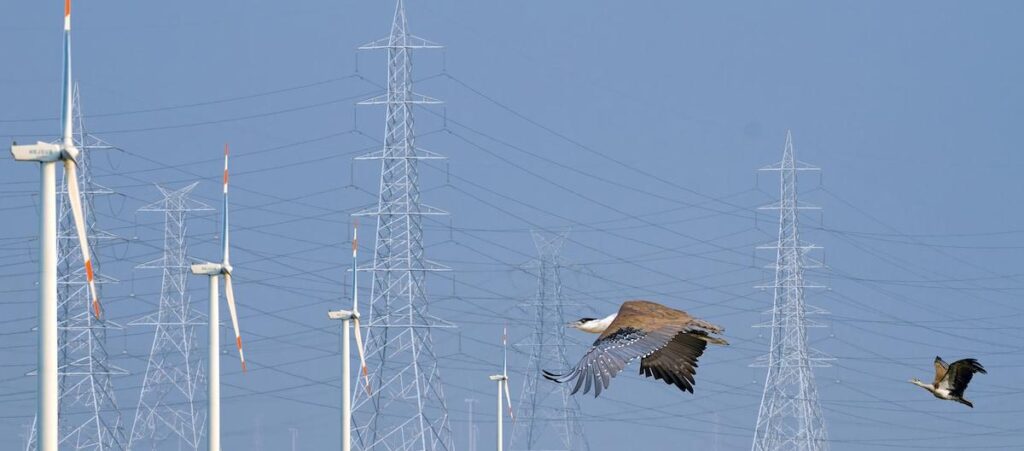
By the Supreme Court’s own account, there may be as few as fifty mature Great Indian Bustards (GIBs) left in the wild. The Court recorded estimates of between 50 and 249 mature birds. The bird, known in Rajasthan as the Godawan (the local name for the GIB), is heavy, slow to turn, and prone to colliding with high-powered power cables running through its habitat.
That is how a bird case became the source of a constitutional climate right. In March 2024, the Court declared a right to be free from the adverse effects of climate change, grounded in Articles 14 and 21 of the Constitution. In December 2025, it finally disposed of the matter. This piece follows the right from one date to the other and argues that the right was real, but the remedy it produced was narrower and more conventional than the headline suggested.
II. A Blanket Order Meets Climate Targets
In April 2021, the Court barred new overhead lines across about 99,000 square kilometres of bustard habitat in Rajasthan and Gujarat, and ordered existing lines to be moved underground. The Union objected. Undergrounding high-voltage lines, it said, was impractical, and India’s renewable energy commitments depended on solar and wind capacity in these very states.
In March 2024, the Court recalibrated. It found no basis for a general prohibition across the 99,000 square kilometres, limited the undergrounding requirement to priority areas of roughly 13,163 square kilometres, subject to feasibility, and handed the details to an expert committee.
III. The Right
Almost as an aside, the judgment did something much larger. Drawing on Articles 14 and 21, together with Article 48A and the fundamental duty in Article 51A(g), the Court held that the Constitution carries a right against the adverse effects of climate change. The right is stated outright, not left to implication. Article 14 did real work too. Climate harm falls unevenly, and the bench noted that forest dwellers and indigenous communities are worse placed than urban populations.
What the judgment did not say is what the right demands of the State. Compare Urgenda v Netherlands, where the Dutch Supreme Court ordered the government to cut emissions, or Neubauer v Germany, where the German Federal Constitutional Court found that climate legislation pushed the burden onto future generations. In Ranjitsinh, the right arrived with no duty attached to it.
IV. The Remedy
The expert committee reported, and on 19 December 2025 a two-judge bench disposed of the case. The directions are specific. The revised priority area is 14,013 square kilometres in Rajasthan and 740 in Gujarat. Future renewable energy projects in Rajasthan’s priority area are restricted. Undergrounding and rerouting must be completed within two years, including 250 kilometres of critical lines identified by the Wildlife Institute of India.
Two things stand out. First, the fear that leaving matters to experts would mean drift has been partly answered. There are maps, lengths, and a deadline. Second, the protection is much smaller than the 2021 order promised. For the area outside the revised priority zones, the committee recommended no blanket restriction on new power lines, and the Court found its measures adequate. The two priority areas together come to about 14,750 square kilometres, a fraction of the 99,000 the Court once covered. On most of the map, the renewable energy argument won.
That may be a sensible trade. But notice what carried the result. As reported, the directions rest on the committee’s recommendations and on conservation law. The climate right does not appear to have done the deciding.
V. Who Pays
The 2024 judgment could fairly be criticised for leaving the energy sector untouched. The December order is more interesting. The Court said that where corporate activity threatens the habitat of an endangered species, the polluter pays principle puts the cost of recovery on the company, and it directed CSR funds towards in-situ and ex-situ conservation. It rooted this in section 135 of the Companies Act, 2013, treating corporate social responsibility as a statutory obligation rather than philanthropy.
This is a quiet innovation: environmental liability routed through company law. It is not, however, a climate remedy, and even courts further down this road have struggled to build one. In Milieudefensie v Shell, the Hague Court of Appeal in November 2024 overturned the order that Shell cut emissions by 45 per cent, while keeping the finding that the company owes a duty to limit them.
VI. Conclusion
A right to be free from the adverse effects of climate change now sits in Indian constitutional law. Its first outing produced a map, a power corridor, and a two-year deadline for a single bird. That is real, and it is not nothing. The harder test comes in a case where nothing so conveniently measurable is at stake, such as heat, floods, or the State’s own climate policy, and a petitioner asks the Court to say what the right requires of the government. Until then, the right is better described as established than as tested.
Sakkcham Singh Parmaar is a law student at Jindal Global Law School, O.P. Jindal Global University.