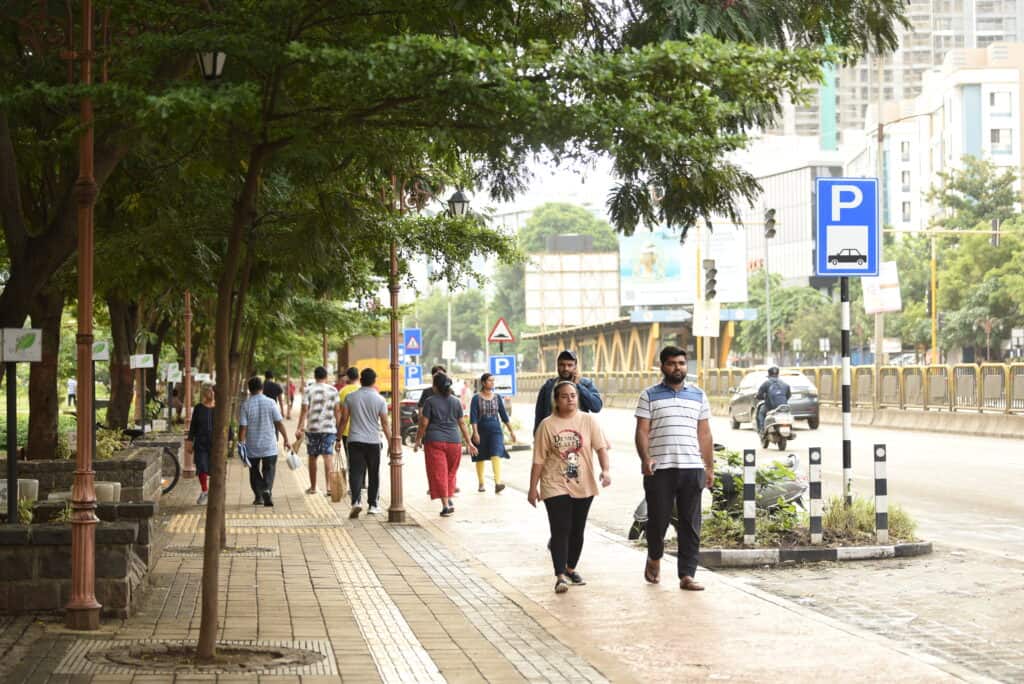
“We have started walking long before wheels were put on our path. The Fundamental Right to Walk precedes the Right to move on wheels”
Justice Pamidighantam Sri Narasimha
A father wakes up his five-year-old son, prepares him for school, and goes outside at 9 am for what’s supposed to be a mundane stroll. They have no footpath under their feet, nor ever did they have one. A tanker passes by shortly after, and the child disappears. In India, this type of death, which is routinely filed away as FIR and a Motor Accident Claim, is forgotten within the week. The Supreme Court of India took a remarkable approach on 19 June 2026, declaring that walking is a fundamental right, and that the footpath beneath a walker’s foot is no longer a civic afterthought, but a constitutional entitlement that supersedes the privilege of the motor vehicle.
I. An Overdue Fundamental Right
A bench of Justices P.S. Narasimha and Atul S. Chandurkar in Maniyar Iliyaz v. P. Ayyappan, found that the Right to Walk is the original Right of movement under Article 19(1)(d) which came before and superseded the Right to Move on Wheels. The Court noted that this omission was an “accident of history,” because the motor vehicle’s widespread availability on the roads made municipal planning focus exclusively on motor vehicles and pedestrians were treated as “a nuisance”, not as rights-holders. The judgment extends beyond safety to a sense of walking in India’s expressive, associational, and cultural life, citing the Dandi March, the Bhoodan Movement, and pilgrimages like the Pandharpur Wari as examples of walking always having been more than just about getting from point A to B. It lays down that there is now, effectively, an obligation on the road-owning authorities, whether municipalities, urban development bodies or panchayats, to create and preserve footpaths wherever a road is present; it holds that the Motor Vehicles Act, 1988, was designed around the vehicle and never intended to be a pedestrian rights act.
It is not a new thread in the Constitution but the boldest statement of it yet. The Supreme Court in Olga Tellis v. Bombay Municipal Corporation had already linked footpaths with the Right to Life and had held that Right to Livelihood was an integral part of the Right to Life, which in turn was linked with the Right to Shelter, even while upholding the authority of the municipality in removing pavement encroachments. This judgment differs from the former in the light of constitutionalising the Right to walk safely on the footpath and not the dweller’s right to occupy the pavement.
II. The Statistical Backdrop
The judgment didn’t come out of nowhere when it comes to the statistics. According to the Ministry of Road Transport and Highways’ Road Accidents in India 2024 Report, almost 485 people died daily from road accidents, or one person nearly every three minutes, across the country, with pedestrians accounting for 20.6 percent of all fatalities, which the report says is due to ongoing gaps in footpaths, safe crossings, traffic calming, and urban road design. The number of fatalities per 100 accidents has also increased, from 21.6 in 2005 to 36.3 in 2024, indicating that Indian roads are not only experiencing higher traffic accidents but increasingly severe ones. The global picture is far from rosy: India is responsible for approximately 13 percent of all road traffic deaths in the world, according to the WHO’s Global Status Report on Road Safety 2023. Vulnerable road users, pedestrians, cyclists and motorcyclists accounted for about 54 percent of all deaths, with pedestrians alone responsible for close to one-third of all the deaths. A study carried out by the Transportation Research and Injury Prevention Centre at IIT Delhi (2024), however, came to the same conclusion from a different perspective: pedestrians, cyclists and motorised two-wheeler riders all accounted for the greatest number of deaths on the road, and only 7 Indian States had helmet-wearing rates above 50%.
III. Structural Roots of Pedestrian Neglect
The statistics are the manifestation of a more subtle but substantial urban design fault. Research has repeatedly shown that only 30 per cent of city roads in India have footpaths, and when they do, they are often narrow, broken or completely covered by informal vending and parking, and encroachment. Research on historic city centres has described the many barriers to walking in a commonplace; these include temporary encroachments, permanent encroachments, the absence of kerb ramps, lack of street lighting, open manholes and storm-water drains that crisscross the walking surface. Research into risk-intelligence on Indian sidewalks has considered this to be a design fault and not a maintenance one: streets are designed for the fast-turning movements of a vehicle, and have little or no refuge space for the pedestrian whose space they must share. The result, as one urban-mobility expert has described it, is that a missing or barren sidewalk is a clear message to the typical commuter that his or her safety is not a priority. This is not a novel piece of information for the policymakers, but this 2026 judgment imposes a constitutional default for decades of documented neglect.
IV. Judicial Trajectory
In fact, the Supreme Court has been moving towards this statement over the past few years with S. Rajaseekaran v. Union of India, which was a public interest litigation filed in 2012 to improve road safety. A bench presided over by Justice Abhay S Oka, in May 2025, held that the right to unobstructed and disability-friendly footpaths fall under Article 21 and ordered every state to draft guidelines for footpath accessibility within a period of two months. The Court, headed by Justices J.B Pardiwala and K.V Viswanathan, took this to a more systematic approach by ordering inspections of footpaths in fifty cities in October 2025, locations where pedestrian deaths and injuries had been reported in the past, and noted that over 35,000 pedestrians lost their lives in road crashes in 2023 alone, with over 54,000 two-wheeler riders dying without helmets.
The Court did not limit it’s scope to footpaths in the city. A bench of Justices J.K. Maheshwari and Atul S. Chandurkar, acting suo motu on the deaths of 34 people in successive crashes along the highways In Re: Phalodi Accident v. National Highways Authority of India noted that the Right to travel safely on roads is also part of the Right to life under Article 21: National Highways which make up only 2 percent of the country’s total road network account for nearly one-third of all road casualties. The Court directed NHAI to clear highway encroachments, identify accident blackspots and establish emergency response infrastructure at least every 75 kilometres. What does the June 2026 judgment in Maniyar Iliyaz do? What it does is take this pile of case-by-case, audit-by-audit, highway-by-highway jurisprudence and turn it into a fundamental right that’s clearly defined, and stands on its own, without a single clear statute being passed to protect it.
V. Statutory Model invoked by The Supreme Court
In an unusual observation in a judgment dismissing a compensation appeal, the Court drew several parallels with the design of the Right of Children to Free and Compulsory Education Act, 2009, the National Food Security Act, 2013, and the Right to Information Act, 2005 among others, to underline how the legislature has fashioned a bare constitutional right into an enforceable framework, including statements of duty, procedures for redress, and the existence of independent regulators like the National Commission for Protection of Child Rights and the Information Commissions. The Court noted that the Right to Walk hasn’t been given such an architecture in the law despite being part of the Article 21 and Article 19(1)(d). The court has instructed its Registry to share the judgment with the Ministries of Housing and Urban Affairs, Rural Development and Road Transport and Highways and the Law Commission of India, seeking their comments on a similar framework.
VI. Justice Recalculated
The doctrine’s human implications were not overlooked in the concluding part of the judgment. The Motor Accident Claims Tribunal had initially provided the bereaved father Rs. 7,82,000 reckoned with interest at 6 per cent which was reduced to Rs. 4,70,000 by the High Court on appeal. The Supreme Court, on the other hand, set aside that reduction, using the income-and-multiplier formula set out in Karuna Parmar v. Prakash Sinha case, which determines a day’s notional pay of the minor on the basis of the notifications issued under the Minimum Wages Act, 1948 raises it by 40 percent to reflect future prospects and reduces the same by 50 percent to account for personal expenses, before applying an age appropriate multiplier, and concluded that the final award ought to be Rs. 11,44,628, covering loss of dependency, loss of consortium, loss of estate and funeral expenses, payable within two months.
VII. Way Forward
In addition to the individual award, the Court has re-numbered the case as a writ petition under Article 32 as Re: Fundamental Right to Walk and Footpath, and impleaded the Union government, through its Ministries of Housing and Urban Affairs, Rural Development and Road Transport and Highways, the Additional Solicitor General of whom it will seek assistance moving forward. This renders what was once a regular motor-accident appeal into a constitutional process which the Court will pursue, the seeds of which were sown in the Rajaseekaran case for the past decade and more. For now, it is an open and closely watched question whether Parliament will follow suit in providing dedicated legislation similar to the Right to Education or the Right to Information; it is an issue that a little boy’s final stroll to school has thrust onto the national agenda.
Aishika Sinha is a Fourth Year B.A.LL.B(Hons.) student at National University of Study and Research in Law, Ranchi